








A decades-long saga surrounding Lithuania’s long-promised national stadium is once again mired in political friction, as coalition partners urge the prime minister to halt funding in favour of regional infrastructure development. Meanwhile, the Lithuanian Football Federation is lobbying for a home in the Naujoji Vilnia district, and the country’s only modern stadium is filled more often with concerts than football matches.
A project 40 years in the making
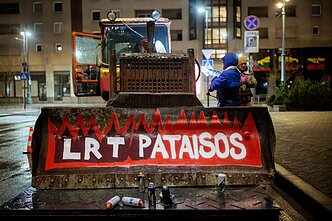
It feels like the Lithuanian national stadium is one of just three never-ending construction projects in the world, journalist and football enthusiast Martynas Starkus said, half-jokingly comparing it to Barcelona’s Sagrada Familia and North Korea’s unfinished Ryugyong Hotel.
Starkus, once a hopeful young player in the Žalgiris Olympic reserve team, now says the drawn-out process has become tiresome. “Over a decade ago, the stadium project turned into a soap opera. Same plot, no progress. It’s like kicking a corpse,” he said.

This month, the Vilnius municipality expects a final ruling from the European Commission on whether the national stadium can get a government subsidy. If no issues are found, the project would move forward under developer Arvydas Avulis and real estate group Hanner.
Prime Minister Gintautas Paluckas is also awaiting the Commission’s decision. Roughly 50 million euros in funding from the Ministry of Education, Science and Sport is earmarked for the stadium portion of the complex. Paluckas has so far backed the project but says he is considering proposals from the Nemunas Dawn party, a coalition partner, to suspend funding.
Members of the Vilnius City Council have also raised objections. Councilman Aleksandras Nemunaitis, speaking at the construction site, argued that the city should not owe any compensation to the developer. “They failed to meet deadlines. The city and the procurement commission should have already acknowledged that,” he said.
Mayor Valdas Benkunskas defended the project, noting that responsibilities are divided: “The government is covering the stadium costs via the Ministry of Education, while the city funds the surrounding infrastructure – fields, a kindergarten, and an arena.”

Shifting the focus to national needs
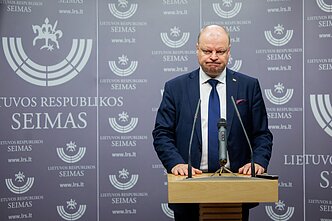
Parliament Speaker Saulius Skvernelis and the Lithuanian Football Federation (LFF) entered the debate last week, stressing not cost-cutting, but the strategic importance of the complex. They raised the question: Should the government focus on a single stadium in Vilnius or invest in infrastructure across the country?
“There’s no scale or professionalism. Kids are forced to play indoors in winter or on artificial turf. We can’t compete like this,” Skvernelis said after meeting with LFF President Edgaras Stankevičius.
Stankevičius also criticised the use of the “national stadium” label for the planned 18,000-seat facility in the Šeškinė area of Vilnius, saying it is too small to warrant that title.

He instead proposed a larger complex further from the city centre, in Naujoji Vilnia, on a 17-hectare site that would include a 25,000–30,000-seat stadium and house the federation’s headquarters. However, the mayor has cited concerns over transparency.
Stankevičius argued that football is the most popular youth sport in the country and that better infrastructure could improve public health, bolster the military’s fitness pool, and enhance national team performance. “Our top priority is indoor facilities for winter. Without those, we can’t develop properly. Only then should we talk about a true national stadium,” he said.
A stadium just for football?
As political leaders debate how best to use the funding, Skvernelis voiced frustration over Kaunas’s Darius and Girėnas Stadium being used more for concerts than for football.
“Had I known it would prioritise concerts over football, the government wouldn’t have given a single euro,” he said.
In reality, dual-use stadiums are common worldwide. With Lithuania’s domestic football still developing, even the Kaunas venue rarely sells out for league matches or national team games.

According to Mantas Vedrickas, head of events at Darius and Girėnas, football is growing – and the stadium, the largest in the Baltics, helps attract major international acts. Four global stars are scheduled to perform there this summer, and the Netherlands national football team will visit in September.
“I’m confident even 15,000 seats in Kaunas won’t be enough for those matches. […] We should think bigger – 30,000 to 40,000,” Vedrickas said.
Across the board, from sports officials to event organisers to politicians, there’s consensus: Lithuania doesn’t need another Kaunas-level stadium. If another is built, it must be truly national in scale.

Vilnius Žalgiris club director Vilma Venslovaitienė echoed that stance. “An 18,000-seat stadium for 56 million euros – 3,000 per seat – is economically sound. Darius and Girėnas cost 50 million euros for a renovation five years ago,” she said.
The number of seats is open to debate, she added, but Vilnius needs a stadium.
What does Lithuania really need?
More football stadiums? Covered winter arenas? Nationwide sports infrastructure? Concert venues? Defence funding?
The answer, according to many, is all of the above – leaving the country with one key challenge: setting its priorities.

Newsletter
Every Friday morning.